
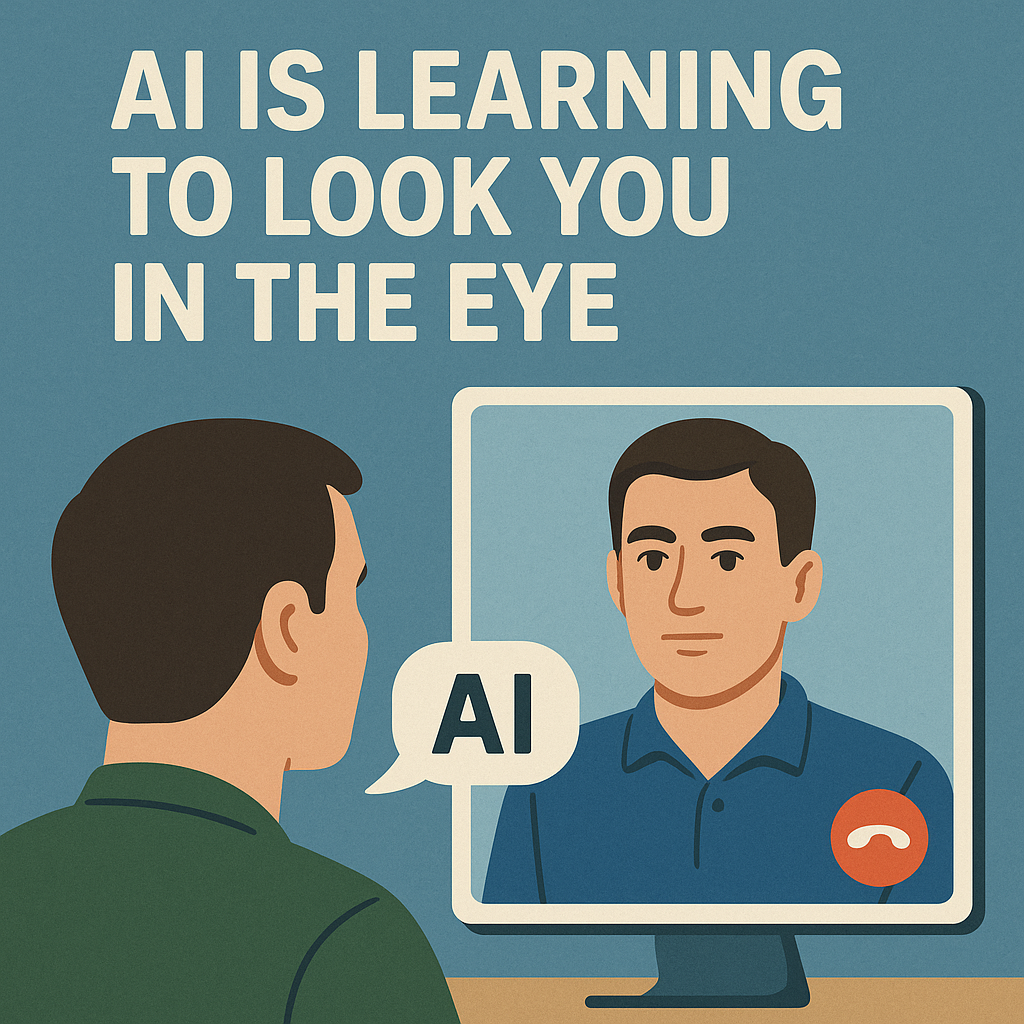
Most people still think of AI as a text box, a sidebar in Word, or maybe a voice assistant at best. But a wave of new systems is pushing hard toward something very different: AI that meets us “face-to-face,” through generated video that looks and behaves like a real person on a video call.
If texting with an AI felt like a big shift, interacting with one that looks back at you will be something else entirely.
The New Frontier: Video That Responds Like a Human
Several companies and research groups are racing to create AI that can generate real-time talking-head video with avatars that nod, blink, gesture, and speak with synced lips and facial expressions.
These include:
Tavus: “Personal AI Humans“
Tavus promotes AI personas (PALs) that can communicate through text, voice, and video. The pitch: your AI companion appears on screen like a real person, remembers your conversations, and “shows up” in video form when needed.
Akool: Video Avatars for Live Interaction
Akool’s technology supports real-time face-swapping and streaming avatars. In theory, this lets an AI present itself in a live video call like a version of you or a digital persona speaking on your behalf.
Research Systems Like OmniTalker & TalkingMachines
These academic projects demonstrate AI that turns text or audio into a synchronized talking head. It’s not just a static face that animates, it has head motion, eye movement, micro-expressions, and even natural timing.
The goal is to reduce the gap between watching a video and being in a video call with an AI.
This is not science fiction and the prototypes already work. The commercial versions will be arriving soon.
Why Do Companies Want AI to Look Human?
Apparently, people communicate differently when they see a face.
- We interpret expressions
- We feel social pressure to respond
- We build attachment faster
- We assign trust without realizing it
Whereas a text interface creates distance, a human face increases compliance.
That’s why the shift from chatbots to video-bots is powerful and obviously potentially dangerous. Once AI systems can “inhabit” a believable visual presence, they gain influence through presentation, not through intelligence.
The Illusion of Presence
Here’s the crucial point:
Just because an AI can look at you doesn’t mean it understands you.
Although the video might “feel” like FaceTime, the “person” on screen has no body, no biography, no skin in the game, no accountability, and no lived experience. It’s simply a graphical rendering stitched together by probability.
But our brain seems to adapt and react to it as if it’s human. That gap between what the machine is and what it looks like is the source of both the innovation and the danger.
What This Means for Everyday Users
For most people, this technology will arrive quietly:
- Customer service bots that appear on screen instead of typing.
- Virtual tutors who “look human.”
- Mental-health companions who speak face-to-face.
- Sales avatars.
- Social media influencers who aren’t real — but feel real.
Some of these implementations will be helpful and no doubt that some will be manipulative. I daresay that all will be persuasive.
The question isn’t whether AI will mimic human presence because it already does in many ways. The question is whether we will remember that presence is not proof of wisdom, empathy, or trustworthiness.
A Future Where AI Has a Face
Face-to-face AI is coming fast. Much faster than regulators, educators, parents, or average users realize. Unlike text or voice, video hits us on a deeper human level. We were shaped to trust faces – just watch a 3-month-old when it sees it’s mother’s face. The people developing these AI systems are in the process of exploiting the aspects of that..
The next few years will force all of us to relearn something that should be obvious:
If the person you’re talking to can be generated, the trust you give them must be earned not assumed.
That’s the real conversation.
I wrote a book called First Response: The Illusion of AI Authority that gets into some of these types of things. It’s available on Amazon here if you’d like to check it out. It’s not a book about artificial intelligence. It’s about how you, we, the collective “us”, think in the presence of it.